Drukyul Walking Tour Bhutan
Punakha & Tharpaling festivals
Grand Walking Tour of Bhutan
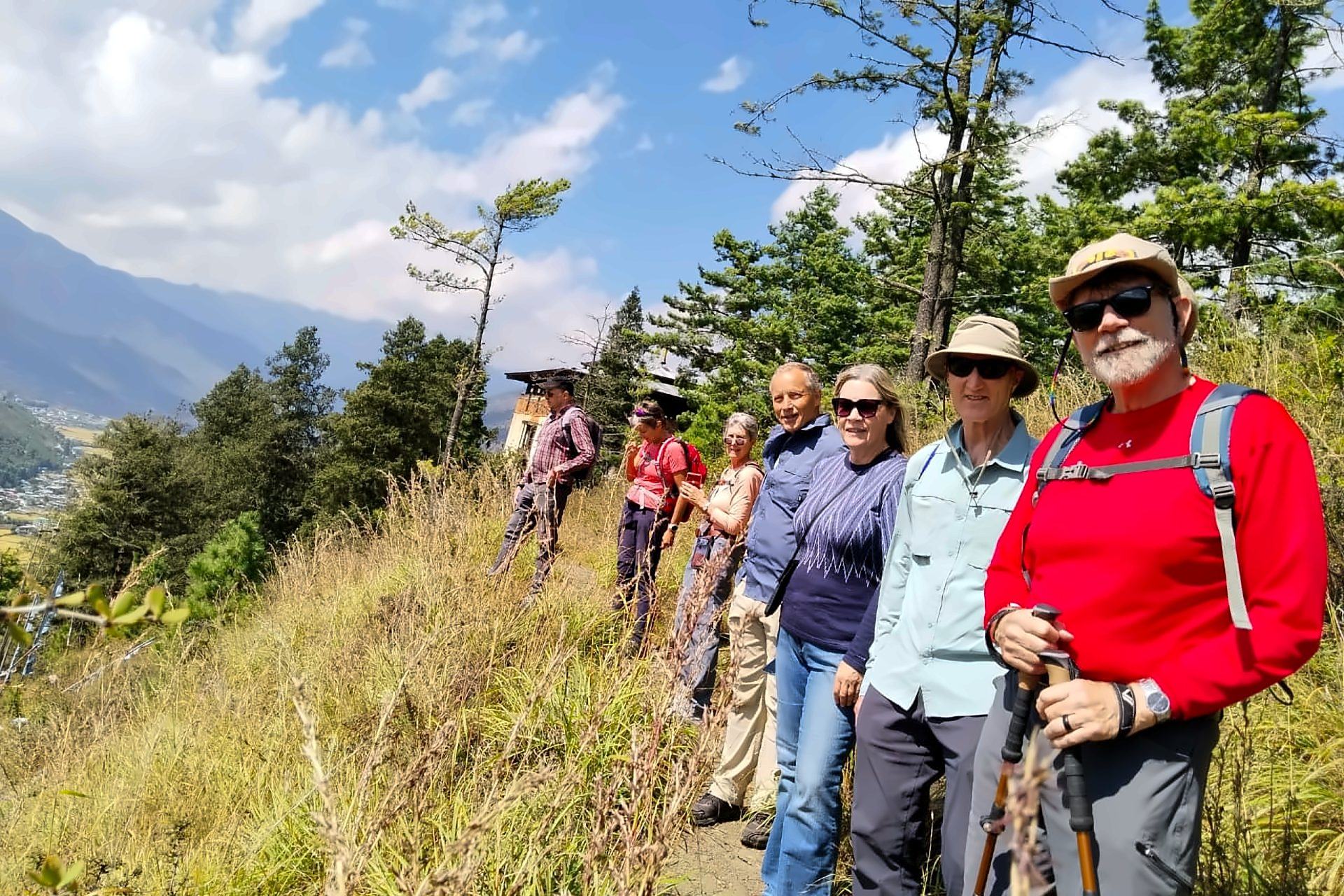
The Drukyul Walking Tour is a 13-day Bhutan walking tour for travellers who want to see the Kingdom on foot, without camping or long trekking days. Each day brings easy to moderate hikes, usually 2–3 hours, through villages, farmland, pine forests and wildflower meadows. Every night you return to a comfortable hotel. First run by Wind Horse in 1999 and refined every year since, it is our signature small group walking tour of Bhutan, with no more than nine travellers on each departure.
Drukyul, “Land of the Thunder Dragon”, is what the Bhutanese call their country, and this journey takes you deep into it. You’ll walk the Paro valley to farmhouses and 7th-century temples, then take a short scenic flight to Bumthang, Bhutan’s spiritual heartland. There you stay at the historic Ogyen Choling Manor in remote Tang valley and walk between the ancient monasteries of Jakar. Cross into Phobjikha valley on the Longtey hike, one of the best day hikes in Bhutan, where black-necked cranes spend the winter. Then descend to Punakha Dzong and walk part of the old Trans Bhutan Trail.
Hiking in Bhutan, at your own pace
The walks build gently through the trip: the Lungchuzekha ridge trail from Dochu La, with views of the Himalaya, then a final hike to Taktsang, the Tiger’s Nest Monastery. On the Taktsang day we go further than most visitors, to the quiet temples above it. Every walk is optional, so this Bhutan hiking tour suits keen walkers and gentler travellers alike.
Culture, festivals and local life
Each small group departure is timed for a Bhutan festival, such as Paro Tsechu, Punakha, Jambay Lhakhang or Trongsa. Along the way you may visit a farmhouse, learn some Bhutanese cooking, hoist prayer flags, join a prayer ceremony, try archery and end the day in a traditional hot stone bath. It’s an active cultural holiday in Bhutan, led by our own expert local guides.
We wholeheartedly believe that walking tours in Bhutan are the most enriching way to savor and encounter Bhutan’s beauty, a philosophy that underscores the tried-and-tested nature of this itinerary honed over the years.
Wind Horse Experiences
Like all Wind Horse small group journeys, Drukyul includes a farmhouse visit, a picnic set up in a picturesque spot, and hoisting prayer flags. Depending on the season and your dates, you may also learn a little Bhutanese cooking, join monks in an aspiration prayer ceremony for the group, relax in a traditional hot stone bath and try your hand at archery.

Activities: Walking Tours, Culture Tours, Village Tours, Festival Tours
For detailed day by day itinerary, contact us
Arrive to a warm welcome, then visit Rinpung Dzong and walk across the old wooden bridge into town. The next day, walk through villages and rice fields to Dumtseg Lhakhang and the 7th-century Kyichu Lhakhang, have lunch in a farmhouse, and visit the cliffside temples of Dzongdrakha.
Two nights in Paro to settle in and acclimatise gently before the flight east to Bumthang.
A short, scenic flight to Bhutan’s heartland. Visit Padselling Monastery, then walk 2 hours over the hills into remote Tang valley. Spend the night at Ogyen Choling Manor, a historic house that is now a museum and heritage guesthouse.
Walk through the Tang villages and stop at the Burning Lake on the way to Jakar Dzong. In the evening, listen to the monks’ debate at Kharchu Dratsang. The next day is a full day on foot linking Jambay Lhakhang, Kurjey and Tamshing, ending at the Swiss Farm.
See weavers at work in Zungney and walk through Domkhar village. Then cross Yotong La to Trongsa to visit its tower museum and the mighty dzong, once the seat of Bhutan’s kings.
One of Bhutan’s finest day hike: climb through old-growth forest to a high, spectacular pass, then come down through yak meadows into Phobjikha, the valley of the black-necked cranes. The hike takes 3–4 hours and is optional.
Start with a morning in Phobjikha, then drive down to warm Wangdue and the clustered village of Rinchengang. The next day, visit Khamsum Yulley Chorten and Punakha Dzong. Then walk about 3 hours on the old Trans Bhutan Trail to Limukha.
Walk the forest ridge from Dochu La to Lungchuzekha, with a picnic at the monastery, before driving into the capital. In Thimphu, see the giant Buddha, take a forest path to Changangkha, and visit the Takin Preserve, the arts school and the colourful farmers’ market.
After breakfast, transfer to Paro International Airport for your onward flight, bringing an unforgettable journey through the Drukyul to a close. The drive from town takes only ten to fifteen minutes, though allow extra time to browse for last-minute souvenirs if your flight schedule permits.
As you fly out over the folds of the Paro valley, you will have fine views of the Himalayan peaks that have accompanied your trip – a fitting farewell to the Land of the Thunder Dragon. Tashi Delek, and we hope to welcome you back to Bhutan again soon.
Climb to the Tiger’s Nest, then carry on to the quiet temples above it for views few visitors see. In the evening, enjoy a farewell dinner and your last night at Jewel Heritage.
Punakha & Tharpaling festivals
Talo & Paro festivals
Domkhar & Ura festivals
Jambay & Prakar festivals
Trongsa festival
Consider this as a private trip, customised to your preferred dates and designed for you or your family alone. Call or email us and we will work through the possibilities with you.
13-day trip, from 3300 per person. Tell us your dates and group size and we will price it exactly.
I recently returned from my 2nd trip to Bhutan and my 2nd tour with WindHorse Tours. Both trips were well organized and fantastic. The first tour was a group tour, the second tour was a custom tour which included a 5-day horse trek. The 2nd tour also happened to occur during the onset of COVID-19 (March 2020). With everything changing…
It is with great pleasure that I write this testimonial. I have been doing adventure travel for over thirty years and while I have been to the Himalayas several times this was my first time in Bhutan. I am happy to say, the concept of Gross National Happiness indeed exists and I have been lucky enough to experience it. My…
We visited Bhutan once again with Wind Horse. The trip was excellent and personalized as we travelled further into the Haa valley where we would have gladly stayed longer. We had a very dedicated and intuitive guide, Tashi, who teamed up with driver Pema. Both were well-versed in Buddhist interpretation of temples and sites (a significant plus!). Small is definitely…
A good sense of humour is the currency that prevail everywhere regardless of the time or circumstances. An asset that that has potential to make even the ordinary trip into extraordinary. Sonam Loday has this traits in abundance. This is intrinsic and come as naturally as bees to the flower.…
One of the guest fondly remarked " Yeshey Penjor may be short in stature but he walks real tall in term of dedication, knowledge and the way he carries and does his work" Except perhaps during the nightmare at night, he wear his smile almost all the time. His soft…
Kezang is a graduate from Gedu Business School college in Bhutan, but he was always interested in the Buddhist Philosophy, which made him alter his ambition to being a tour Guide. He is super polite and Buddhist to the core, because his parents and their parents were all affliliated to…
Pema Dhendup is the one among the few young guns at Wind Horse Tour, Bhutan. He possess an infectious smile and exuberance that rub off to child and old alike. Unwarily, he has a mature head on his young shoulder and it is most conspicuous when he is among guests,…
Fitness: if you walk regularly and can manage 2–4 hours on hill paths, you’ll enjoy every day.
This Drukyul Walking Tour suits travellers who want to see Bhutan in depth, at a gentle pace, without the demands of a trekking expedition. Expect easy to moderate walks of two to four hours most days – through farmland, forests and villages – combined with comfortable hotel stays every night rather than camping. It’s ideal for curious, reasonably fit travellers of most ages who want a genuine cultural immersion, a taste of local festivals, and time in the off-the-beaten-path valleys of Bumthang and Phobjikha, alongside the classic sights of Paro, Punakha and Thimphu.
Fly into Paro International Airport, where your Wind Horse guide and driver will meet you on arrival. If you are joining a group departure timed around a festival, please arrive a day early where possible to allow for any flight delays. Your guide will confirm exact pick-up details and any last-minute schedule notes once your flights are booked.
All visitors to Bhutan require a visa, which Wind Horse Tours arranges on your behalf once your booking is confirmed. We will need a copy of your passport and a PP size photo . Visa processing and fees are included in the trip price, and your electronic visa clearance is sent to you.
All meals are included throughout the trip, with breakfasts and dinners typically at your hotel and lunches at local restaurants along the route. Bhutanese cuisine centres on rice, seasonal vegetables and dishes flavoured with chilli and cheese, such as ema datshi, alongside international options for those who prefer milder food. Your guide will happily help you find restaurants serving local specialities, farmhouse meals and Bhutanese butter tea if you would like to try them.
Bhutan’s climate varies with altitude and season. Spring (March to May) and autumn (September to November) bring the clearest skies and are also when many of the trip’s festivals take place. Winter (December to February) is cold, especially at night, but usually dry and sunny, making touring pleasant even if trekking isn’t advisable. Layered clothing is recommended year-round, as mornings and evenings can be cool even when days are warm.
Every visitor to Bhutan contributes to the country’s Sustainable Development Fee, which funds free education, healthcare and environmental conservation. Wind Horse Tours further supports this by using local hotels, guides and drivers throughout the trip, working with village homestays and community initiatives where possible, and encouraging responsible, low-impact travel that respects Bhutan’s culture, environment and ‘high value, low volume’ tourism philosophy.
What travelers most often ask us before a trip to Bhutan.
Yes—but specific regulations still apply.
Since 2022, Bhutan has relaxed the former mandatory “all-inclusive” tour model. Under the country’s High Value, Low Volume tourism policy, travelers now have greater flexibility, while certain services remain regulated.
Here’s how independent travel in Bhutan works:
What you can arrange yourself
Independent exploration
Once in Bhutan, you may explore the streets, shops, cafés, and restaurants of Thimphu and Paro independently. A guide is not required for walking around town, shopping, or dining in these two valleys.
When a guide is mandatory:
A licensed Bhutanese guide is required for:
Guides are required to protect sacred sites, ensure visitor safety, and comply with national tourism regulations.
Transportation rules
While you may walk independently within city centers, tourists are generally not permitted to use public transport for inter-district travel. Travel between towns must be arranged using a registered private vehicle with a licensed driver.
Why many independent travelers still choose an agent
Although independent booking is possible, coordinating:
can be complex. In practice, many travelers find that arranging guides, vehicles, and permits independently can result in higher overall costs and added complexity, rather than the flexibility they initially expect
At Wind Horse Tours, we support independent travelers by offering:
.
The most popular times to visit Bhutan are spring (March–May) and autumn (late September–November), offering the best combination of weather, scenery, and cultural experiences.
Your passport must be valid for at least six months from your date of arrival in Bhutan.
Indian citizens:
Indian passport holders may travel using a valid passport, or alternatively, an original Voter ID card may be used in place of a passport.
You will need on digital passport size photo to apply visa yourself or you can send one to your Bhutan Tour Operator
For the best experience, we recommend booking 9 months to a year in advance if you plan to travel during the peak seasons: Spring (March–May) or Autumn (September–November). This is especially critical if your dates coincide with or fall near a major festival.
Why such a long lead time?
Bhutan has a very limited tourism infrastructure compared to other destinations, and the best options sell out quickly.
Limited Flight Capacity: Bhutan is served by only two airlines (Drukair and Bhutan Airlines), each operating a small fleet of international aircraft.
Internal flights are even more restricted, often operated by a single ATR aircraft with fewer than 40–50 seats. During peak months, these seats are often the first to disappear.
Hotels: Many of the most highly-regarded hotels are small, in some cases with fewer than 20 rooms. If you have your heart set on good hotels, you must book early to secure your spot.
The Advantage of Booking Early
If you are sure you want to visit, there is every reason to book as soon as possible. Even if your plans aren’t 100% finalized, booking early provides a safety net:
Risk-Free Booking: You can “lock in” your flights and preferred hotels now and still have the flexibility to cancel up to 3 months before your trip. In most cases, there are hardly any cancellation charges (check with us on the minimal cancellation fees imposed by the airline and the hotels)
Off-Peak Season: For travel during non-peak periods, booking 3–4 months in advance is usually sufficient. and we have have even managed to arrange successful “last-minute” trips in as little as 10 days. Do not hesitate to contact us and we will try our best make your visit successful
The Bottom Line: If you want the best rooms and the most convenient flight times for 2026 or 2027, the earlier you book, the better. Whichever country you may be travelling to (Bhutan, Nepal, India or Tibet), the same logic apply.
No, it is not necessary. Visitors are not expected to bring gifts or offerings when visiting temples or monasteries.
However, small offerings are welcome and appreciated. Traditionally, Bhutanese pilgrims may offer a kadar (ceremonial scarf), a small amount of loose change, or make offerings such as butter lamps or fruits. If you wish to participate, these items are usually available for purchase near major temples and monasteries.
Making an offering is entirely optional and should be done only if it feels meaningful to you.
Winter days in Bhutan are often sunny, but nights can drop below freezing in core valleys such as Paro and Thimphu.
Average daytime temperatures in Paro, Thimphu, and other areas of similar altitude (including Gasa and Trongsa) range between 8°C and 14°C (46°F–57°F). Nighttime temperatures typically fall between –5°C and –1°C (23°F–30°F).
Punakha and Wangdue, which lie at a lower elevation than Paro and Thimphu, are noticeably warmer. Daytime temperatures average 16°C to 20°C (61°F–68°F), while nighttime temperatures range from 3°C to 8°C (37°F–46°F).
Bumthang and Gangtey (Phobjikha) valleys are located at higher elevations and therefore experience colder winters. Average daytime temperatures range from 4°C to 10°C (39°F–50°F), and nighttime temperatures can drop to between –5°C and 1°C (23°F–34°F).
The southern towns—including Phuentsholing, Gelephu, and Samdrup Jongkhar, as well as other settlements along the Indian border—enjoy mild and pleasant winter weather with dry, crisp air. Average daytime temperatures range from 23°C to 25°C (73°F–77°F), and nighttime temperatures typically range between 13°C and 15°C (55°F–59°F).
Eastern Bhutan, including Trashigang, Mongar, and Lhuentse, is generally warmer than the western and central regions. These districts experience a semi-tropical to temperate climate, making them comfortable for winter travel. Average daytime temperatures range from 13°C to 21°C (55°F–70°F), with nighttime temperatures averaging 3°C to 10°C (37°F–50°F).
No. Unless you are visiting Bhutan for a government-sanctioned project or a pre-approved professional documentary, drones are not permitted.
As of 2026, the Bhutan Civil Aviation Authority (BCAA) enforces some of the world’s strictest drone regulations. Recreational and private drone use is completely prohibited for both tourists and residents.
Using a drone without prior written authorization can result in heavy penalties, affecting both the traveler and the local host or tour operator.
Drukyul Walking Tour Bhutan