Annapurna Circuit Trek
Dashain Festival
Encircling the Annapurna Massif
The Annapurna Circuit Trek remains a premier adventure for those craving a comprehensive Himalayan experience. Encircling the mighty Annapurna Massif, this trek delivers a dynamic blend of mountain grandeur, cultural immersion, spiritual discovery, and physical challenge—all within a thoughtfully structured yet thrilling journey.
This route is not merely a physical journey—it unfolds as a spiritual, cultural, and natural odyssey. Trek through lush valleys and rhododendron forests, experience Tibetan-influenced villages, traverse barren high-altitude deserts, and conquer the soaring Thorong La Pass—all while being shadowed by the majestic Himalayan peaks.
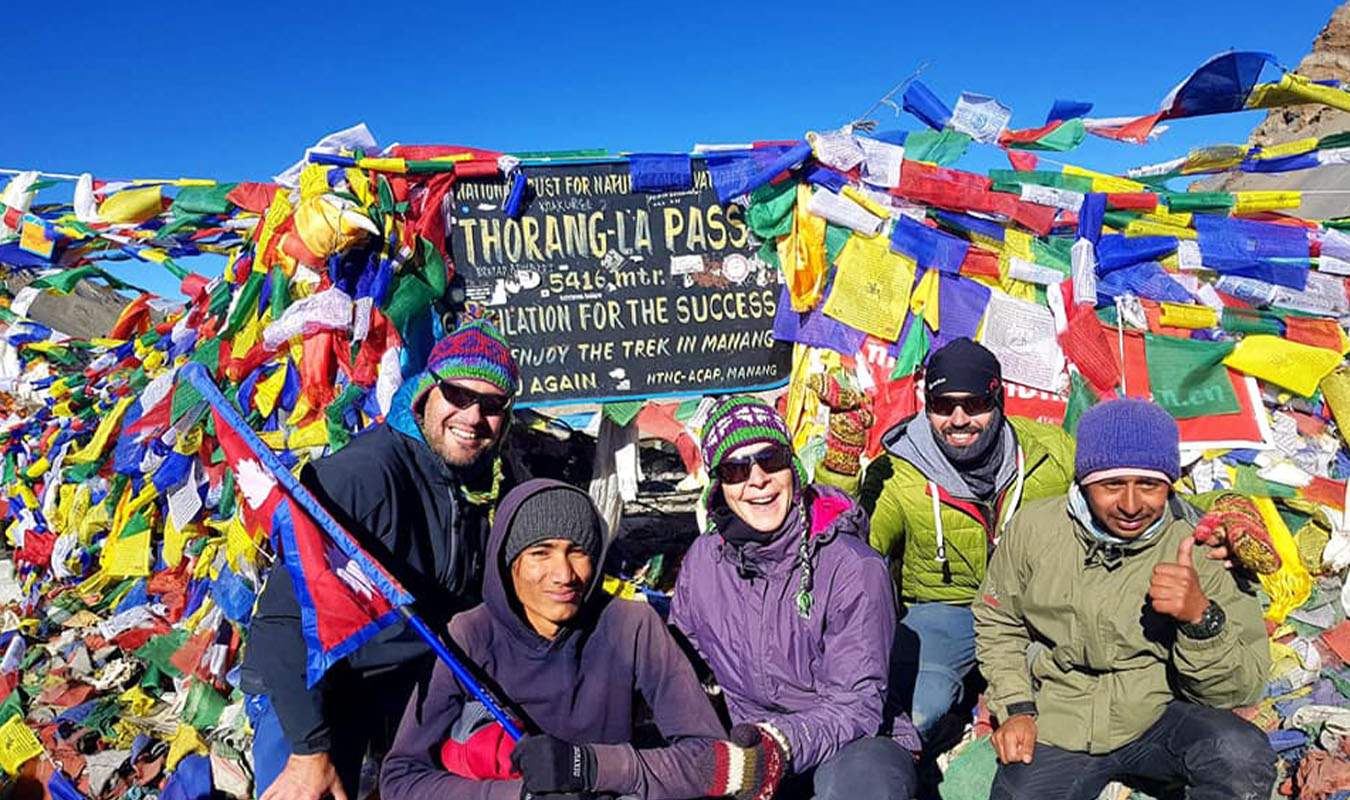
Crossing Thorong La (5,416 m) marks a defining moment: a testament to your stamina and spirit. The reward? Sweeping panoramic views of Annapurna, Dhaulagiri, Manaslu, Gangapurna, Nilgiri, and Tilicho Peak. After the pass, the terrain shifts dramatically as you descend into the Mustang region—a high Tibetan-flavored landscape of arid valleys, wind-sculpted monasteries, and time-frozen villages.
Wind Horse Tours brings this epic trek to life through expert logistics, genuine cultural connection, and attention to your pace. Each day brings a sense of achievement, each village a story to hear, and each vista a vivid memory.
The Annapurna Circuit Trek is more than a journey—it’s a life-enriching odyssey. From whispering prayer flags to mountain-sized panoramas; from spiritual retreat to cultural immersion, it offers a transformational experience that lingers long after your return.
Day 1. Arrival in Kathmandu
Day 2. In Kathmandu
Day 3. Drive from Kathmandu to Tal
Day 4. Drive from Tal to Manang
Day 5. In Manang (exploration day)
Day 6. In Manang (exploration day)
Day 7. Trek from Manang to Yak Kharka
Day 8. Trek from Yak Kharka to Thorong Phedi
Day 9. Trek from Thorong Phedi to Muktinath (via the Thorong La pass)
Day 10. Drive from Muktinath to Pokhara
Day 11. Fly from Pokhara to Kathmandu
Day 12. Departure
Activities: Trekking
The full day-by-day itinerary.
Upon your arrival at Kathmandu airport, a Wind Horse representative will meet and greet you before transferring you to your hotel. No activities are planned for this day, so you will have the rest of the day at your leisure until the evening. Later in the evening, your trip guide will meet you and present you with a brief orientation about the trek. After the briefing, you will enjoy dinner at a traditional Nepalese restaurant with a cultural performance.
Today, you will visit three UNESCO World Heritage Sites in the Kathmandu Valley: Kathmandu Durbar Square, Boudhanath Stupa, and Pashupatinath Temple.
Kathmandu Durbar Square is one of the three Durbar (palace) squares in Kathmandu valley. Kathmandu Durbar Square is rich with its intricate wood carving and its history. Also known as the “Musuem of Temples” there are over 50 temples in the square. You will explore the area around the former palace of the kings of Nepal, viewing various temples and monuments.
Following this, you will drive to Boudanath Stupa. Boudanath Stupa is one of the largest Buddhist stupa in Nepal and also a World Heritage Site. Boudanath signifies peace and tranquility, and is a Centre of religious and spiritual significance. You will see thousands of pilgrims circumambulating the stupa, you will circumambulate with pilgrims and visit the surrounding monasteries.
Afterward, you will proceed to Pashupatinath Temple. The Pashupatinath temple is situated on the banks of the Bagmati river and is one of the most revered Hindu temple in Nepal. The main temple complex is only open to Hindus. Although non Hindus are not allowed the temple complex is large and quite impressive.
The journey from Kathmandu to Tal via Besisahar presents breathtaking views of the Nepalese countryside. The road follows the Marshyangdi river and takes you through charming villages such Bulbule, Ngadi, Syange, Jagat, Chyamje, to Tal.
Tal is a picturesque village situated in an open valley on the banks of the Marshyangdi river with a beautiful waterfall at the background.
After breakfast, you will begin your journey towards Manang, the drive goes past several villages along the way such as Dharapani, Tanchowk, Chame, Bhratang, Humde, and Bhraka.
Along the way, you will stop at several places to explore around. You will explore by short walks and drives, you will explore around Tanchowk, Dharapani. You will stop by Chame, the headquarter of the Manang district, and a popular stopover in the Annapurna Circuit Trek. You will visit some local homes and experience the local culture and traditions.
Hereafter, you will continue further along the route and stop at Lower Pisang with the views of Upper Pisang on the opposite hill. You can crossover the Marshyangdi river, take a short walk and visit the green lake.
After this you will continue further and stop at Humde village. Humde is a charming village offering beautiful views of the surrounding mountains such as Annapurna II, Gangapurna and other towering peaks, and the Marshyangdi river valley.
Next, you will continue further to Braga. Braga is popular for Braga monastery, an ancient monastery which holds immense cultural and religious significance in this area. You will explore the Braga Monastery, which is known for its intricate woodworks, exquisite architecture, with a notable collection of religious artifacts.
After the visit, you will continue towards Manang. Manang is situated on a broad valley on the banks of the Marshyangdi river, with the spectacular views of the surrounding mountain peaks. All trekkers trekking the Annapurna Circuit Trek or the Tilicho lake trek stop by for acclimatization in Manang.
Acclimatization is crucial when trekking at high altitudes like the Thorong La Pass (5,416m). This helps the body adjust to the surrounding atmosphere and prevents altitude sickness. Manang is a perfect place for acclimatize. Manang offer a mixture of natural wonders and cultural riches, there are wide collection of lakes, waterfalls, and traditional villages.
Manang is a travelers paradise with its breathtaking landscape and tranquil surrounding. Most trekkers spend one night in Manang, whereas you will spend two nights in Manang, before heading towards Thorong La Pass. There are several options for a day’s hike from Manang, each offering unique experiences and breathtaking views.
You can hike to Praken Gompa, this is relatively a short hike compared to other hikes. Praken Gompa situated at 3945 m offers breathtaking views of the valley below and the surrounding mountians such as the Annapurna II, Annapurna IV, Gangapurna, and others.
There is also the option to hike to Khangsar, a small Tibetan style village on the route to Tilicho lake. Khangsar provides fantastic views of Tilicho Peak. The journey takes about 2-3 hrs one way, the trail goes above the Marshyangdi river with great views. There is also the option to take a short hike and visit the Gangapurna lake, a turquoise blue lake just an hour away from Manang.
For those who are more adventurous, there is the option to visit Milarepa Cave or Ice Lake for high altitude walk.
The hike to Milarepa cave is longer; it will take about 4-5 hours round trip. Milarepa cave is the place where the Tibetan saint and poet Milarepa had meditated. This cave has an immense religious value, thousands of pilgrims from Nepal, India, Bhutan, as well the neighboring Tibet visit this cave every year.
Another more popular hike from Manang is the Ice lake hike. This hike is one of the most demanding hike, it takes about 5-6 hours round trip from Manang. The climb is not that difficult but the altitude and the wind may make it difficult. Moreover, the ice lake hike will serve you as a preparation for the much longer Thorong La pass hike.
The trek from Manang to Yak Kharka is one of the shortest in this Annapurna Circuit Trek. the trail goes with great views along the way.
Leaving Manang, you will encounter a small stream before ascending uphill toward the village of Tenki. Continuing further, you’ll gradually ascend out of the Marshyangdi Valley in a northwest direction, following the valley of Jarshang Khola.
As you continue further the landscape becomes more dry and the vegetation gets more sparser. The trail guides you through scenic meadow, offering a beautiful environment. Along the trail, you will come across yak pastures, and scrub juniper forests, past the village of Ghunsang.
After crossing a wooden bridge that spans a small river, passing by an ancient stone wall adorned with inscriptions, you will finally arrive at the small village of Yak Kharka.
The hike to Thorong Phedi isn’t strenuous in terms of technical difficulty, but the diminishing oxygen levels pose a physical demand. Initially the trail climbs out of Yak Kharka, and then it gets gradual beyond Ledar descending towards Jarshang Khola.
The valley gets more narrower and steep sided as you move forward. The landscape becomes more barren and rocky, and the views great with good views of the surrounding peaks. After about 4 hours or more you will finally arrive at Thorong Phedi.
Thorong Phedi is the last village before you cross the Thorong La Pass, therefore you will take time to acclimate and rest adequately before continuing towards the Thorong La pass.
Crossing the Thorong La Pass is a challenging adventure. Starting early would be a wise decision, given the altitude and potential weather conditions. The steep ascent can present challenges, particularly with melting snow, so exercising caution we will begin your journey.
The Pass itself is not difficult, it is wide and open. The trail is wide and easy to follow, but the climb is long and gradual until Thorong La. The Thorong La Pass at 5,416 meters is breathtaking. The panoramic view of the surrounding snow-capped peaks, stretching into Tibet, is a sight to behold.
Taking in some time to soak in this majestic 360-degree view and capturing the moments in your camera, you will then descend slowly towards Muktinath. Muktinath – a sacred place for Hindus and Buddhists. For the Hindus, it is the Muktichetra , the place of Nirvana. For the Buddhists it Chumig Gyatsa, which in Tibetan means Hundred Waters.
Today you will head back towards Pokhara in a private jeep, past the villages of Kagbeni, Marpha, Tatopani via the Beni Jomsom road. On reaching Pokhara, you will check into your hotel and the afternoon is free to explore around the lakeside area.
After breakfast, our guide and driver will accompany you to the Pokhara airport for your departure flight to Kathmandu. Once you arrive in Kathmandu, our representative will welcome you and facilitate your transfer to the hotel. You’ll have the rest of the day to yourself.
Transfer to the airport in time for your departure flight.
Dashain Festival
Tihar Festival
Shivaratri
Nepali New Year
Consider this as a private trip, customised to your preferred dates and designed for you or your family alone. Call or email us and we will work through the possibilities with you.
12-day trip, from US$ 1180 per person. Tell us your dates and group size and we will price it exactly.
Answers written for this itinerary. The general Nepal questions that apply to it are linked from our FAQ page.
The trek is one of Nepal’s most iconic trekking routes, circling the Annapurna massif. It offers a diverse journey through:
The trek’s defining highlight is crossing Thorong La Pass (5,416 m)—one of the highest trekking passes in the world—offering breathtaking 360° views of the Himalayas.
This trek is consistently ranked among the world’s best because it combines:
It’s not just a trek—it’s a complete Himalayan experience blending nature, culture, and adventure.
This trek is considered moderate to strenuous, making it suitable for fit beginners as well as experienced trekkers.
Expect:
The most challenging section is crossing Thorong La Pass, which requires endurance, proper acclimatization, and mental resilience.
The duration varies depending on your itinerary and pace:
Optional side trips include Tilicho Lake and Nar Phu Valley.
The highest point is Thorong La Pass (5,416 m).
At this altitude:
Crossings are typically done early in the morning for safety and more stable conditions.
The best seasons are Spring (March–May) and Autumn (September–November).
No prior trekking experience is required, but good physical fitness is essential.
You should be able to walk several hours per day for multiple consecutive days.
With proper preparation, acclimatization, and determination, most people can complete the trek successfully.
For this trek you You will require the Annapurna Conservation Area Permit (ACAP).
Yes. As of July 2023, all foreign trekkers in Nepal must be accompanied by a licensed guide. A guide helps with:
Porters are optional but highly recommended if you prefer to trek comfortably without carrying heavy luggage.
Teahouses are small, family-run lodges along the trail offering:
Facilities become more basic at higher elevations.
Teahouses serve a mix of Nepali and Western dishes, including:
Drinks include tea, coffee, hot chocolate, lemon drinks, and soft drinks.
No, drinking water is not included.
You can buy bottled or boiled water (prices increase with altitude). We recommend you use a reusable bottle with purification tablets or a filter (cost effective).
Mobile coverage is available in lower regions but becomes weak or unavailable at higher elevations.
Yes, WiFi is available in many teahouses, but it becomes slower and more expensive at higher altitudes.
Yes. Most lodges provide facilities to charge phones, and other electronic devices with an extra cost. In some remote locations, charging may be limited or powered by solar energy.
Yes, it is the primary concern above 3,000 m. Common symptoms include: Headache, Nausea, Fatigue. and Dizziness.
Itineraries are designed with:
Guides are trained in first aid and altitude sickness (AMS) management
Absolutely—comprehensive travel insurance is a must. It should explicitly cover high-altitude trekking, emergency medical treatment, and helicopter evacuation above 5,000 m.
You should be comfortably active, capable of walking 6–8 hours per day over rugged terrain, including uphill climbs. It’s best to prepare with cardiovascular workouts and strength training before your trek.
Typically, Annapurna Circuit Trek packages range from USD 1,200 to USD 1,600 per person, depending on group size. The package includes:
Budget around USD 15–20 per day for extras such as:
There are no ATMs along the route, so carry enough cash in Nepali currency.
Yes, tipping is customary in Nepal’s trekking industry and is a way to show appreciation for guides and porters.
Annapurna Circuit Trek