

The Nar Phu Valley Trek is a remote and off-the-beaten-path Himalayan journey located between the Annapurna region and Manaslu region. This trek takes you into a restricted area known for its untouched landscapes, dramatic mountain scenery, and well-preserved Tibetan-influenced culture, offering a truly authentic and less crowded trekking experience.
Nar Phu Valley Trek
A Journey to the secret valleys of the Himalayas
Nar Phu Valley Trek: Discover Nepal’s Hidden Himalayan Gem
Nestled between the renowned Annapurna and Manaslu regions, the Nar Phu Valley Trek is a remote Himalayan odyssey that rewards intrepid trekkers with untouched wilderness, rich Tibetan-Buddhist culture, and panoramic mountain vistas. Closed to outsiders until 2002, Nar Phu remains one of Nepal’s best-kept secrets—its narrow gorges, ancient monasteries, and medieval villages offering a raw, authentic experience far from the crowds.
The Nar Phu Valley Trek is Nepal’s untold secret—a harmonious blend of Tibetan-Buddhist heritage, spectacular alpine scenery, and rugged adventure. For those ready to step off the beaten path and into Himalayan solitude, this trek offers spiritual insight and natural grandeur in equal measure. Whether trekking through village tea houses, pausing in prayer at remote gompas, or cresting Kang La Pass, every moment here resonates with discovery.
What choose the Nar Phu valley Trek?
- Off-the-Beaten-Path: Unlike busy trekking routes, Nar Phu remains uncrowded. You’ll trek through forgotten villages—Nar, Phu, Nar Phedi—tucked amid towering peaks, in a landscape that feels untouched and private.
- Living Tibetan Culture: Villages like Phu and Nar have preserved their Tibetan identity—stone homes, prayer rituals, and traditional farms remain anchored in centuries-old heritage.
- Remote Wilderness & Variety: Traversing lush forest, stark alpine desert, icy gorges, and mountain passes, this trek reveals a dramatic shift in ecosystems and terrain—each segment more breathtaking than the last.
- Spiritual Sanctuaries: Remote monasteries like Tashi Lhakhang and Nar Phedi are not just scenic stops—they are places of ritual, practice, and genuine encounter with Tibetan Buddhist life.
- Spectacular Mountain Views: Surrounded by 6,000–8,000 m giants such as Annapurna II, III, & IV, Gangapurna, Manaslu, Himlung, Chulu, and Tilicho, the trek’s vistas from high passes and villages are spectacular and pristine.
- High Mountain Passes: The classic route includes crossing Kang La Pass (5,306 m) and optionally linking to the Thorong La Pass (5,416 m) via the Annapurna Circuit. These are challenging but highly rewarding crossings, offering expansive views and a sense of major accomplishment.
Highlights of Nar Phu Valley Trek
- UNESCO Heritage Sites: Explore iconic World Heritage Sites like Kathmandu & Patan Durbar Squares, Swayambhunath, Boudhanath, Pashupatinath, and before setting off
- Scenic Approach:Enjoy scenic drives from Kathmandu to Koto via Besishahar, passing river valleys, terraced fields, and forests.
- Off-the-beaten-path trekking: Walk less-crowded trails across remote terrain, immersing yourself deeply in nature.
- Ancient Monasteries & Spiritual Life: Marvel at Tashi Lhakhang Gompa in Phu and the serene Nar Phedi Monastic Institute—both offer rare chances to observe monks and nuns in evening chants and rituals.
- Remote Villages: Visit Nar and Phu—traditional Tibetan-style stone villages where daily life unfolds as it has for centuries: locals spinning yak wool, weaving carpets, grinding mustard, and tending to blue sheep.
- Varied and Dramatic Landscapes: Trek through forests of pine and rhododendron, deep gorges, arid alpine plateaus, and glaciated ridges beneath towering skies.
- Spectacular Mountain Views: Ascend the challenging Kang La Pass to gain sweeping panoramas of towering peaks like Annapurna II–IV, Gangapurna, Himlung, Himlung base, and Chulu peaks
- Flora & Fauna Encounters: Spot Himalayan blue sheep and possibly elusive snow leopards in remote stretches.
Who is this Nar Phu Valley Trek for?
This Nar Phu Valley Trek is for experienced hikers seeking solitude, cultural depth, and a sense of adventure far off the beaten track. It’s ideal for those intrigued by Tibetan heritage and remote monastic life, offering a rare glimpse into living spiritual traditions.
Nar Phu Valley Trek itinerary
Day 1. Arrival in Kathmandu
Day 2. In Kathmandu
Day 3. Drive from Kathmandu to Koto
Day 4. Trek from Koto to Meta
Day 5. Trek from Meta to Phu
Day 6. In Phu (Exploration day)
Day 7. Trek from Phu to Nar Phedi
Day 8. Trek from Nar Phedi to Nar
Day 9. Trek from Nar to Ngawal (via Kang La Pass)
Day 10. Trek from Ngawal to Manang
Day 11. In Manang (Exploration day)
Day 12. Drive from Manang to Kurintar
Day 13. Drive to Kathmandu
Day 14. Departure
Activities: Trekking
Day by day
The full day-by-day itinerary.
Upon your arrival at Kathmandu airport, a Wind Horse representative will meet you and transfer you to your hotel. The rest of the day is at your leisure until the evening. Later in the evening, there will be a briefing followed by dinner, along with a cultural performance, at a traditional Nepalese restaurant.
Overnight in Kathmandu Meals Dinner
Today, you will visit three UNESCO World Heritage Sites in the Kathmandu Valley: Kathmandu Durbar Square, Boudhanath Stupa, and Pashupatinath Temple.
At Kathmandu Durbar Square, you will explore the area around the former palace of the kings of Nepal, viewing various temples and monuments.
Following the visit, you will drive to Boudhanath Stupa, the largest Buddhist stupa in Nepal. Here, you will circumambulate with pilgrims and visit the surrounding monasteries.
Later, you will proceed to the holiest Hindu temple in Nepal, Pashupatinath Temple. The evening is free for you to shop for any last supplies or gear needed for your upcoming trek.
Overnight in Kathmandu Meals Breakfast
The journey from Kathmandu to Koto provides a diverse and scenic experience, passing through numerous villages, showcasing the natural beauty of Nepal’s landscapes. The drive initially follows the Trishuli River along the Kathmandu Pokhara Highway and then takes a diversion at Dumre towards Besisahar.
The change in the scenery as you depart from the main highway to Pokhara at Dumre and proceed towards Besisahar provides a more intimate view of the countryside. From Besi Sahar, the drive goes past the charming villages such as Jagat, Chamje, Dharapani, Bagarchhap, Timang, and Thanchock, with the views of the famous Annapurna I, Mount Manaslu and Lamjung Himal along the way.
Overnight in Koto Meals Breakfast · Lunch · Dinner
This morning your guide will verify your RAP at the check point, and begin your hike. You will cross over the Marshyangdi river, and walk along the banks of Nar Khola. The trail goes through beautiful pine forests, suspension bridges, and waterfalls along the banks of Nar Khola and Soti Khola, past the tea houses of Cheche and arrive at Dharmashala.
After Dharmashala, the vegetation changes, thick forest gives way to sparsely scattered bushes. As you climb higher the landscape becomes broader and more panoramic with views of Pisang peak, Kangri Himal and Lamjung Himal along the way. The final segment of your hike involves a steep uphill climb until Meta, a small village situated on a flat plateau with panoramic views of distant snow-capped peaks.
Overnight in Meta Meals Breakfast · Lunch · Dinner
Starting from the valley along the river, the trail traverses areas with sparse vegetation and scattered grasslands. It passes through the semi-permanent settlement of Chyako, where remnants of the Khampa settlement can be seen. This is one of the most beautiful section of this Nar Phu Valley trek.
Along the journey, the trail undulates with several ascents and descents before reaching Kyang. Kyang is a small settlement offering beautiful vistas of Annapurna II and Pisang Peak. The trail goes alongside the Phu Khola, with the opportunity to spot the distinctive blue sheep for which the valley is renowned. You’ll also come across unique chortens that hold cultural significance, for which Nar and Phu is popular for.
As you approach Phu, you will catch the first glimpse of the charming village. Continuing on a descending path, you will cross the Phu Khola over a rocky trail, and arrive at the Phu gate, which marks the entrance to the village.
Overnight in Phu Meals Breakfast · Lunch · Dinner
It’s recommended to dedicate an acclimatization day in Phu due to the high altitude. To maximize this day, exploring the village will be an excellent option.
During this exploration day, you will get the opportunity to immerse in the local culture. Today, you’ll visit local homes, interact with the locals, and observe their traditions and daily lifestyle, and gain cultural insight.
You also have the option to visit the Tashi Lakhang monastery, one of the oldest monastery in Manang district. The monastery sits high above Phu village, with the view of Phu village and the surrounding area.
Apart from this, you also have the option to hike to Himlung Base Camp. This trail winds through a picturesque valley, offering breathtaking views throughout the journey, it takes 5-6 hours for a round trip.
Overnight in Phu village Meals Breakfast · Lunch · Dinner
This morning you will descend past Kyang and Chyako to Nar Phedi. The trail passes through the settlement of Chyako and the remnants of the Khampa settlement. These ruins provide a fascinating glimpse into the area’s historical past, offering insight into its intriguing history and heritage. You have the option to spend the night at Chyako or continue further for an hour to Nar Phedi.
The hike is a gradual downhill through a changing landscape, crossing the Phu Khola, and eventually ascending towards Nar Phedi. Nar Phedi is a small village with breathtaking views of Pisang Peak and other surrounding peaks.
Overnight in Nar Phedi Meals Breakfast · Lunch · Dinner
Leaving Nar Phedi, you will ascend uphill towards Nar, the largest village in the Nar Phu Valley. The hike follows a winding trail through two mountain passes standing at 5050m(Nar) and 5400m(Phu) and cross over a suspension bridge.
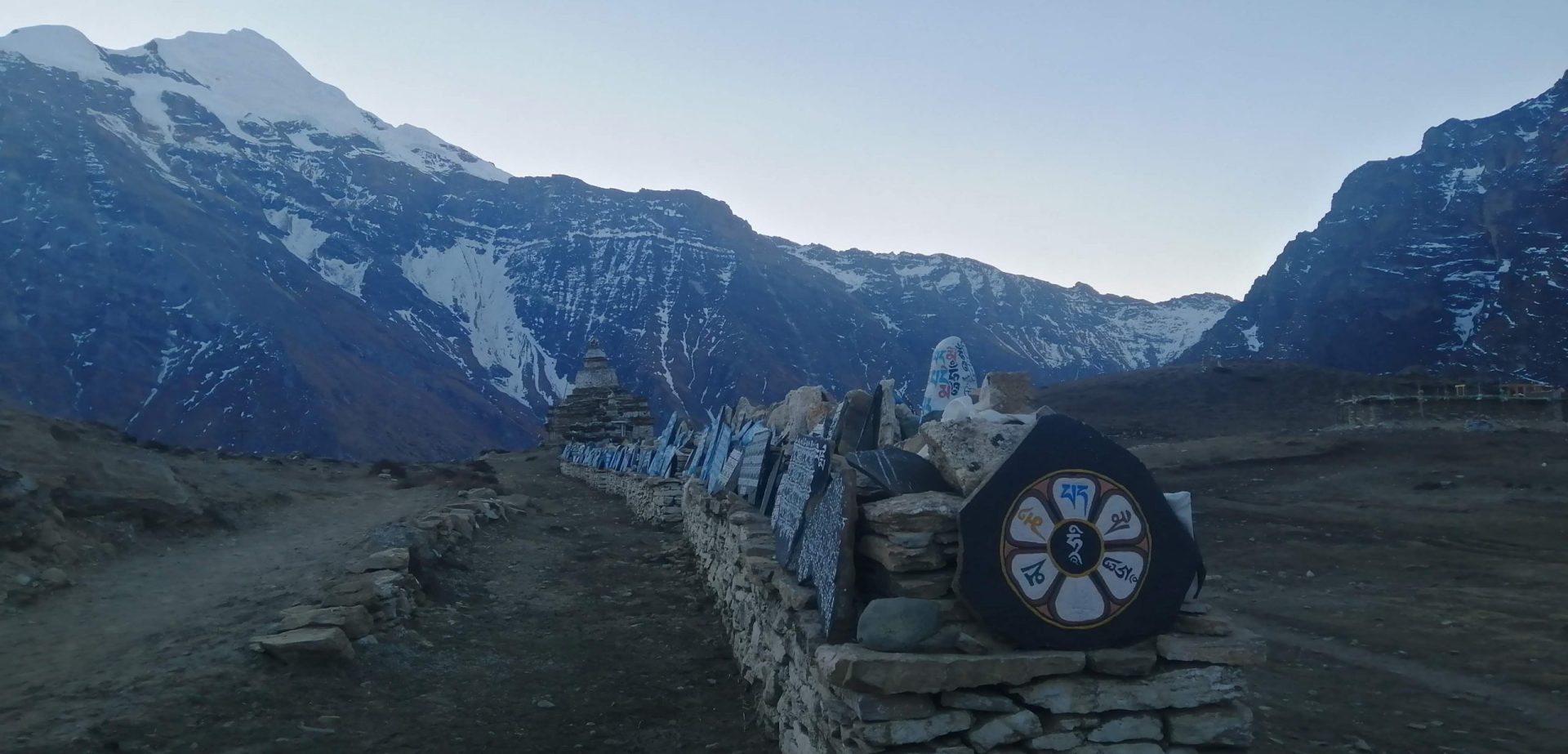
The trail follows through, barren landscapes, yak pastures, beautifully painted chortens, and Mani walls with the views of Pisang peak and others at the background.
You’ll arrive at Nar Village around noon. Following lunch, the rest of the day will be dedicated to exploring Nar Village and its surroundings, providing an opportunity to interact with locals and gain insight into their lifestyle.
Overnight in Nar Meals Breakfast · Lunch · Dinner
You will start early in the morning to prepare for the potential challenges posed by snow on the pass. The pass itself is not difficult, but the weather conditions can turn the journey into a lengthy and demanding .
The ascent goes through the lateral moraine of the Temdenzon Khola, traversing yak pastures with stunning views of the Pisang peak until you reach Kang la Phedi-the base of the Kang La pass.
From Kang La Phedi, it is a gradual and steady ascent lasting approximately 2 hours until you reach Kang La Pass. The pass presents breathtaking panoramic views of Pisang Peak, Annapurna II, Gangapurna, and Tilicho Peak.
After admiring the beautiful views, and after capturing the beautiful moment, you will then descend through pasturelands and yak herders’ campsite and arrive at Ngawal on the Upper Pisang route of the Annapurna Circuit trek.
Overnight in Ngawal Meals Breakfast · Lunch · Dinner
After a relaxed breakfast, you will continue towards Manang. Today will be the shortest day in this Nar Phu Valley trek. Today you will hike from Ngawal to Manang, the hike goes mostly over dirt road. Along the way, you will stop at Braga.
Braga is popular for Braga monastery, an ancient monastery which holds immense cultural and religious significance in this area. You will explore the Braga Monastery, which is known for its intricate woodworks, exquisite architecture, with a notable collection of religious artifacts.
After the visit, you will continue further to Manang. Manang is situated on a broad valley on the banks of the Marshyangdi river with the spectacular views of the surrounding mountain peaks.
Overnight in Manang Meals Breakfast · Lunch · Dinner
Today is set as a free day to explore around Manang. There are several options for a day’s hike from Manang, each offering unique experiences and breathtaking views.
You can hike to Praken Gompa, this is relatively a short hike compared to other hikes. Praken Gompa situated at 3945 m offers breathtaking views of the valley below and the surrounding mountians such as the Annapurna II, Annapurna IV, and Gangapurna.
There is also the option to hike to Khangsar, a small Tibetan style village on the route to Tilicho lake. Khangsar provides fantastic views of Tilicho Peak. There is also the option to take a short hike and visit the Gangapurna lake, a tourquise blue lake just an hour from Manang. For those who are more adventurous, there is the option to visit Milarepa Cave or Ice Lake for longer high altitude walk.
The hike to Milarepa cave is longer, it will take about 5-6 hours round trip. Milarepa cave is the place where the Tibetan saint and poet Milarepa had meditated. This cave has an immense religious value, thousands of pilgrims from Nepal as well neighbouring Tibet visit this cave every year.
Another longer hike from Manang is the Ice lake hike, this hike is one of the most demanding hike from Manang. The climb is not that difficult but the altitude and the wind may make it difficult.
From here onwards, one can continue on the Annapurna Circuit Trek as per the below itinerary:
Day 12. Trek to Yak Kharka
Day 13. Trek to Thorong Phedi
Day 14. Trek to Muktinath(via the Thorong La pass)
Day 15. Drive to Pokhara
Day 16. Fly to Kathmandu
Day 17. Departure
Overnight in Manang Meals Breakfast · Lunch · Dinner
Today, you will end your Nar Phu Valley Trek adventure and drive back to Besisahar. From Besisahar, you will continue over the same route towards Kathmandu. Since it will be too long a drive from Manang to Kathmandu, therefore you will stop at Kurintar for the night. Kurintar is a small village on the banks of the Trishuli river along the Kathmandu Pokhara highway.
Overnight in Kurintar Meals Breakfast · Lunch · Dinner
After breakfast, you will continue your journey towards Kathmandu. You will arrive at Kathmandu before lunch time. On arrival check in to your hotel and the rest of the afternoon is free to rest and relax or go souvenir shopping.
Overnight in Kathmandu Meals Breakfast
Transfer to the airport in time as per your flight schedule to your next destination.
Meals Breakfast
14-day trip, from US$ 1365 per person. Tell us your dates and group size and we will price it exactly.
Included
- All transfers by private vehicle.
- Accommodation in 3-4* category hotels in Kathmandu, tourist standard hotels in Manang and Kurintar, and local tea house lodges during the trek with attached bathroom where possible.
- Only breakfast during the stay in Kathmandu.
- Three standard meals (breakfast/lunch/dinner) with some hot drinks during the trek.
- One welcome dinner with a cultural performance in Kathmandu.
- 1 full day guided city tour in Kathmandu.
- Transfer from Kathmandu-Koto-Manang-Kathmandu in a private 4W jeep.
- English-speaking licensed trekking guide along with a porter (1 porter for every two trekkers).
- Duffel bag, and trekking map.
- Trekking staff accommodation, wages, meals, trekking gears, and insurance.
- All necessary paperwork and permits for the trek (ACAP/RAP).
- All government tax and service charges.
Not included
- Nepal Visa.
- International airfare.
- Meals other than listed (lunch and dinner in Kathmandu).
- Personal expenses (laundry, telephone, bar, beverages).
- Bottled/boiled water, battery recharge, Wi-Fi and hot showers during the trek.
- Tips and gratuities to Guide, Porter and driver.
- Travel medical insurance covering rescue and emergency evacuation.
- Personal trekking gears and equipments.
- Trip cancellation cost due to your health, weather condition, political situation, and any other unforeseen events.
- Any other expenses other than the listed above.
- Best Months — March, April, May, October, November
- Good Months — September
- Lean Months — June, July, August
- Not Recommended Months — January, February, December
Answers written for this itinerary. The general Nepal questions that apply to it are linked from our FAQ page.
This Nar Phu Valley Trek is unique for its remote, less-visited trails that offer a peaceful and uncrowded experience. It features authentic Tibetan-style villages like Nar Village and Phu Village, rich Buddhist culture with ancient monasteries, and dramatic scenery that shifts from lush valleys to high-altitude desert landscapes.
The Nar Phu Valley lies in the remote northern section of Annapurna Conservation Area, close to the Tibetan border. It combines the raw Himalayan wilderness with ancient Tibetan-influenced culture.
To reach the trail head you will take a long drive from Kathmandu to Besisahar and then continue on towards Koto, which serves as the main gateway to the valley. The journey typically takes about 8–10 hours, passing through scenic landscapes.
The Nar Phu Valley Trek is considered moderate to challenging, involving rough, steep terrain and daily hikes of around 5–7 hours. You’ll also cross Kang La Pass at roughly 5,300 m, so proper fitness and altitude acclimatization are essential
No, this trek is not recommended for complete beginners. It requires good physical fitness, altitude readiness, and some previous trekking experience due to its remoteness, elevation, and demanding terrain.
- Exploration of Nar and Phu villages
- Visit to Tashi Lhakhang Monastery
- Crossing Kang La Pass
- Panoramic views of Annapurna, Manaslu, and Himlung Himal peaks
The best seasons are:
- Spring (March–May): Pleasant temperatures and blooming landscapes
- Autumn (September–November): Clear skies and excellent visibility
The region lies in a rain-shadow area, making it more accessible even during light monsoon periods.
The trek offers a striking variety of terrain, including:
- Forests and river valleys in the lower sections
- Narrow gorges and rugged trails
- High-altitude desert landscapes resembling Tibet
- Glacier-fed valleys and dramatic mountain backdrops
You must obtain Nar Phu Restricted Area Permit and the Annapurna Conservation Area Permit (ACAP), which can be only issued through a government registered trekking agency and requires at least two members in a group.
Yes, all required permits are arranged and included in your trekking package.
No, permits must be issued through a registered trekking agency. Additionally, at least two trekkers are required to obtain the Restricted Area Permit.
Yes, a licensed guide is mandatory. Solo independent trekking is not allowed. Moreover guides enhance safety, share cultural insight, and support throughout the journey.
The highest point is Kang La Pass (5,320 meters). At this elevation, the air is significantly thinner, making proper acclimatization essential.
Teahouses in this region are more basic compared to popular trekking routes like Everest or Annapurna. They typically offer:
- Simple twin-sharing rooms
- Limited facilities due to remoteness
- Basic dining areas with local meals with occasional western dishes
Most accommodations are twin-sharing. Single rooms may be available in some villages but are limited and cannot be guaranteed.
Teahouses serve simple meals such as:
- Dal Bhat (rice, lentils, vegetables)
- Noodles, soups, pasta, and fried rice
- Eggs, pancakes, porridge, and Tibetan bread and occasional western dishes
Food variety decreases as you go higher.
Yes, drinking water is available with an extra cost. Bottled and boiled water gets more expensive at higher elevation. We recommend reusable water bottles with purification tablets for safety and sustainability.
Mobile coverage is very limited and often unavailable in most parts of the Nar Phu Valley due to its remote location.
WiFi availability is limited:
- Rare in Nar and Phu villages
- Occasionally available in lower areas like Koto or Manang
- Typically slow and unreliable
Yes, but:
- Charging facilities are limited
- Often powered by solar energy
- Available at an additional cost
Yes, altitude sickness is concern in this trek. The trek goes over 4000 meters and over 5000 meters at the Kang la Pass. Therefore proper planning, hydration, and rest days are essential.
- Experienced, licensed trekking guide
- Basic first aid kit
- Proper acclimatization schedule
Yes, travel insurance is mandatory and must cover:
- High-altitude trekking (above 5,000 m)
- Emergency evacuation (including helicopter rescue)
- Medical treatment
You should:
- Stay well hydrated (3–4 liters daily)
- Ascend gradually and follow your guide’s pace
- Avoid alcohol and smoking at altitude
- Carry personal medications
Essential items include:
- Warm layered clothing (including down jacket)
- Sturdy trekking boots
- Personal first aid kit
- Water purification tablets or filter
You should budget around USD 15–20 per person per day for extras like bottled water, snacks and beverages, hot showers, and charging and wifi. Since there is no ATM’s along the route, exchange sufficient cash in local currency to last for the entire trek.
Yes, you can hire a porter to help you with your luggage, a licensed guide is still required to do this trek as per the government regulation.